It’s mid-August, 3 p.m., and the conference center you manage holds 300 guests. The room feels fine, then suddenly the rooftop unit shuts off. Temperatures rise, guests start fanning themselves, and you wonder if the 18-year-old system has finally quit.
You glance at the controls, listen to the fans, and wonder how a single piece of equipment can disrupt an entire operation. Facility managers, asset planners, and even tenants face this scenario every year. The real question isn’t just when the system will fail. It’s how long it should last and what you can do to extend its service life.
Understanding Commercial HVAC Lifespan
The lifespan of a commercial HVAC system is not a fixed number. It is a range influenced by maintenance, environment, and usage. According to the American Society of Heating, Refrigerating and Air-Conditioning Engineers (ASHRAE), the median service life of a commercial rooftop unit (RTU) is 15 years. Yet well-maintained systems can often deliver 20 to 25 years of reliable service, saving building owners six-figures in replacement costs and keeping equipment out of landfills.
Why do some units fail at 12 years while their twins run strong past 20? The answer lies in factors like run time, preventive maintenance cadence, installation quality, and environmental conditions. Understanding these levers lets you make informed decisions and stretch the life of your equipment.
The Typical Lifespan at a Glance
| Equipment Type | Expected Life* |
| Rooftop packaged unit (RTU) | 15 years |
| Variable Refrigerant Flow (VRF) heat pump | 18 years |
| Water-cooled chiller | 20 years |
| Condensing boiler | 15 years |
| Cooling tower | 20 years |
Source: ASHRAE life expectancy guidance summarized in the HVAC Applications Handbook.
Expected life reflects median industry estimates. Actual lifespan varies based on maintenance, load, and environment.
Why RTUs Top Out First
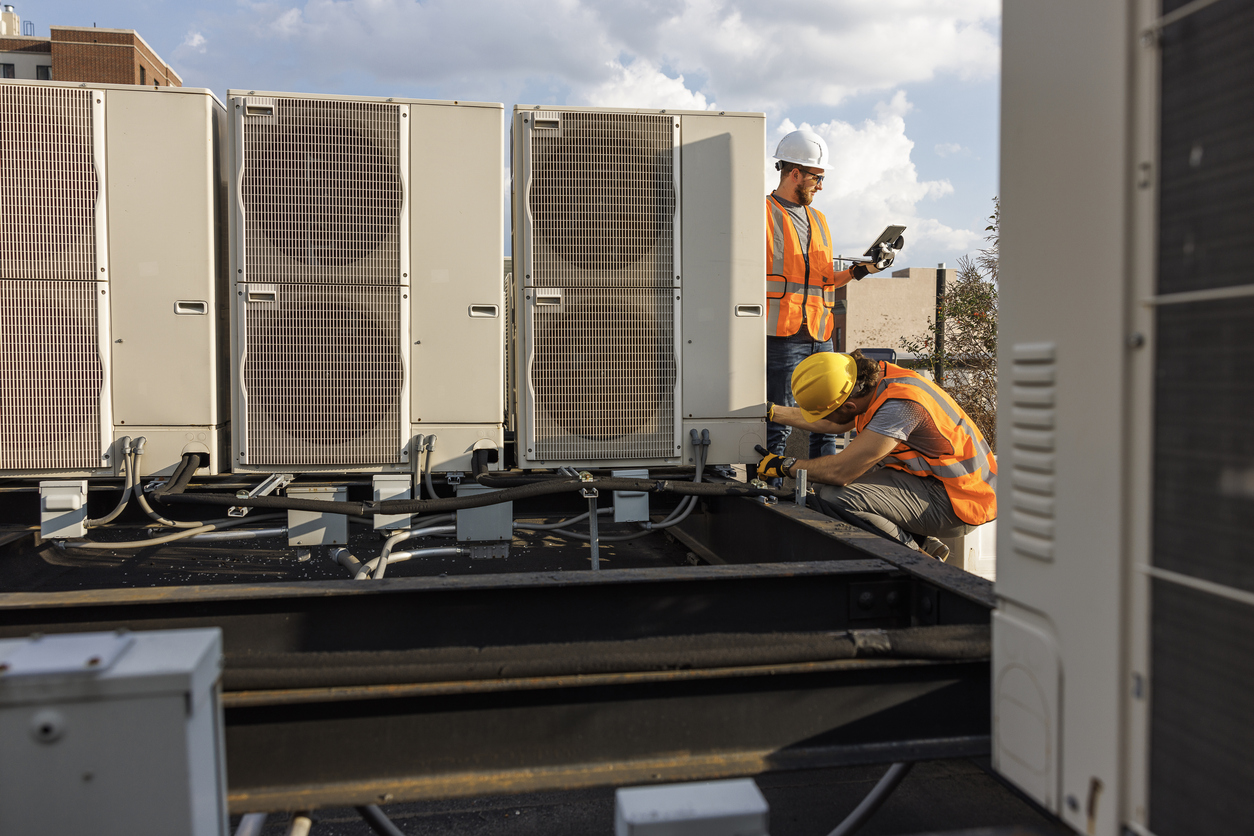
RTUs sit exposed on rooftops, facing heat, weather, and airborne debris year-round. Chillers and VRF modules live in gentler spaces, giving them a few extra years.
7 Factors That Shrink or Stretch Service Life
- Run Time and Load – Equipment that operates near full capacity for long stretches accumulates wear much faster than systems with balanced duty cycles. Constant high load shortens motor and compressor life.
- Preventive Maintenance Cadence – Skipping routine maintenance allows small issues to grow. Dirty coils, worn belts, and low refrigerant increase energy use and push compressors toward early failure.
- Installation Quality and Sizing – Improper sizing shortens lifespan. Oversized units short-cycle, while undersized units run continuously. Both conditions strain motors, controls, and electrical components.
- Climate and Environment – Environmental exposure matters. Coastal salt, desert dust, and heavy pollen degrade coils, clog filters, and corrode electrical connections at different rates.
- Filtration – Inadequate filtration lets dust coat heat exchange surfaces. As airflow drops, systems run longer and hotter, accelerating wear.
- Controls Strategy – Poor setpoints and unstable schedules cause frequent starts and stops. These short cycles quietly reduce the life of compressors, contactors, and drives.
- Human Error – Simple mistakes still cause outsized damage. Incorrect fuse sizing, improper wiring, or skipped lockout steps can destroy a motor in seconds.
Hypothetical Scenario: Extending the Life of an Aging RTU
Consider a mid-size hotel operating a rooftop unit well past its expected service life. Replacement was on the table, but a condition assessment showed the unit’s major components were still sound.
Instead of a full change-out, the team corrected control settings, replaced worn electrical and mechanical parts, and reduced unnecessary cycling. The work focused on lowering stress on the compressor and motors rather than restoring the unit to “like-new” condition.
According to ASHRAE service-life guidance, HVAC systems that remain structurally sound and are properly maintained can often operate beyond their nominal lifespan. In this case, targeted repairs helped extend useful service and delay capital replacement.
You now know the averages and the risks. Next, let’s look at practical steps you can take this quarter to protect the equipment you already own.
Your Maintenance & Monitoring Checklist
Quarterly Tasks
Each quarter, technicians should check belt tension and pulley alignment to limit mechanical wear. Refrigerant superheat and subcool should be measured to confirm proper charge, while condenser and evaporator coils are cleaned to protect efficiency. Building automation sensors also need calibration so control systems respond accurately to real conditions.
Annual Deep-Dive
Once a year, motors should undergo meg-ohm testing to catch insulation breakdown before failure. Full filter sets are replaced using the correct MERV rating specified in the system design. Boilers require combustion analysis to verify safe operation, and BAS firmware updates help improve both reliability and cybersecurity.
For expert help staying on schedule, explore our Planned Maintenance services tailored to commercial HVAC systems.
Repair or Replace? The 50% Rule + Simple ROI Math
ASHRAE offers a practical guideline often called the 50% Rule. It suggests replacement when a repair costs more than half the price of a new unit and the equipment has already reached about 75% of its expected service life. At that point, major repairs rarely pay off for long.
For example, consider a 12 year old rooftop unit that originally cost $20,000. If it needs a $10,000 compressor, the decision sits right on that threshold. This is where life cycle cost analysis matters. Newer HVAC systems built to current Department of Energy efficiency standards can reduce energy use significantly. When projected utility savings can offset the cost of replacement within five years, replacement is often the smarter financial choice. A proper ROI analysis helps owners compare repair costs, energy savings, and remaining service life before committing either way.
4 Tactics to Squeeze 25 Years from Your System
- Upgrade to EC fan motors – Electronically commutated motors reduce energy use and provide gentler starts, cutting wear on fans and belts.
- Install variable-speed drives – Matching output to demand reduces constant cycling, extending the life of compressors and pumps.
- Add coil coatings in coastal areas – Protective coatings shield heat exchange surfaces from salt and moisture, preventing corrosion for minimal cost.
- Use predictive analytics – Tools supported by remote monitoring detect vibration changes, bearing noise, or temperature spikes early, letting you fix issues before they lead to downtime.
Next Steps: Partner With Camali Corp
Camali Corp’s design-build HVAC services, paired with 24/7 emergency support, keep facilities comfortable, compliant, and cost-efficient. Schedule a no-pressure asset-life audit by calling (949) 580-0250 or booking a visit online.