When your data center’s power fails at 2 a.m., or your server room starts overheating on the hottest day of the year, who do you call?
That’s not a question you want to answer in the middle of a crisis. Yet every year, thousands of facility managers find themselves scrambling to find qualified technicians while their systems and their businesses hang in the balance.
Here’s the uncomfortable truth: data center downtime is expensive, and the losses add up fast. Over the course of a two-hour outage, the cost can easily exceed $1 million. Two of the most common trouble spots are UPS failures and HVAC issues, which makes choosing the right service partner critical.
The good news? Most of this downtime is preventable. The key is partnering with the right service provider before disaster strikes.
Why UPS Replacement and HVAC Maintenance Matter More Than Ever
Modern facilities face a perfect storm of challenges. AI workloads are pushing power densities to unprecedented levels. Aging infrastructure struggles to keep pace with demand. And the margin for error keeps shrinking.
Consider what’s at stake:
- A single UPS battery failure can cascade into a complete power loss, taking down servers, corrupting data, and halting operations
- An HVAC malfunction can push server room temperatures past safe thresholds in minutes, triggering automatic shutdowns or permanent hardware damage
- Deferred maintenance makes these risks worse over time, and small problems can turn into major failures
The U.S. Department of Energy notes that predictive maintenance programs can lower costs by 8% to 12% compared to preventive maintenance alone, with even greater savings possible over run-to-failure practices. That is not just about avoiding downtime. It also helps improve efficiency and extend equipment life.
What Makes a Top-Tier UPS and HVAC Service Provider?
Not all service providers are created equal. When evaluating UPS replacement services and commercial HVAC maintenance partners, look for these critical differentiators:
1. Single-Source Accountability
The best providers can support both electrical and mechanical systems under one roof. That matters because power and cooling are closely connected. A UPS upgrade may affect heat loads, while an HVAC retrofit may impact power distribution.
When multiple contractors are involved, communication gaps can create risk. Schedules slip, details get missed, and accountability becomes less clear.
Single-source partnerships help reduce those coordination issues and can make service delivery more efficient.
2. Vendor-Agnostic Expertise
Your facility probably contains equipment from multiple manufacturers, including Schneider Electric UPS units, Trane HVAC systems, and Eaton PDUs. The best service providers maintain certifications across all major brands, so they can service whatever you have without pushing unnecessary replacements.
3. 24/7 Emergency Response
Critical infrastructure doesn’t fail on a convenient schedule. Your service partner needs to answer the phone at 3 a.m. on a holiday weekend and have technicians who can actually show up.
4. Proactive Maintenance Programs
The shift from reactive to predictive maintenance is one of the biggest advances in facility management. Instead of waiting for a failure, many facilities now use sensors, thermal imaging, and data analytics to spot warning signs early and reduce the risk of costly downtime.
5. Proven Track Record
Ask for references from similar facilities. A provider who excels at small office buildings might struggle with the complexity of a Tier III data center. Look for experience in your specific industry and facility type.
Leading Firms in UPS Replacement and HVAC Maintenance
The market includes both global manufacturers who offer service programs and specialized independent providers. Here’s how the landscape breaks down:
Major UPS Manufacturers with Service Programs
| Company | Strengths | Best For |
| Schneider Electric (APC) | Largest installed base, EcoStruxure monitoring platform | Enterprise data centers, facilities with existing APC equipment |
| Vertiv | High-efficiency systems, AI workload expertise | Hyperscale facilities, high-density environments |
| Eaton | 25% market share in static UPS, strong industrial focus | Manufacturing, industrial applications |
| ABB | Medium-voltage expertise, grid-interactive solutions | Large facilities, utility-scale applications |
Leading HVAC Service Providers
| Company | Strengths | Best For |
| Carrier | Global reach, comprehensive service programs | Multi-site commercial portfolios |
| Trane | Reliability testing leadership, commercial expertise | Office buildings, institutional facilities |
| Comfort Systems USA | 190 locations nationwide, $9.1B revenue | Large-scale commercial and industrial |
| Daikin | Manufacturing scale, inverter technology | Energy-efficient retrofits |
Integrated Critical Infrastructure Providers
For facilities that need both UPS and HVAC support, some critical infrastructure providers offer significant advantages:
- Camali Corp, a California-based company that has been family-owned since 1988, serves data centers, hospitals, and commercial facilities with electrical, mechanical, and IT services under one roof.
- Quality Uptime Services provides nationwide UPS and HVAC maintenance, and specializes in data center environments.
- ABM Technical Solutions provides facilities services, including critical power and cooling.
How to Evaluate and Select Your Service Partner
Use this checklist when comparing providers:
Technical Capabilities:
- Certifications for your specific equipment brands
- Experience with your facility type (data center, hospital, manufacturing)
- Predictive maintenance capabilities (thermal imaging, vibration analysis)
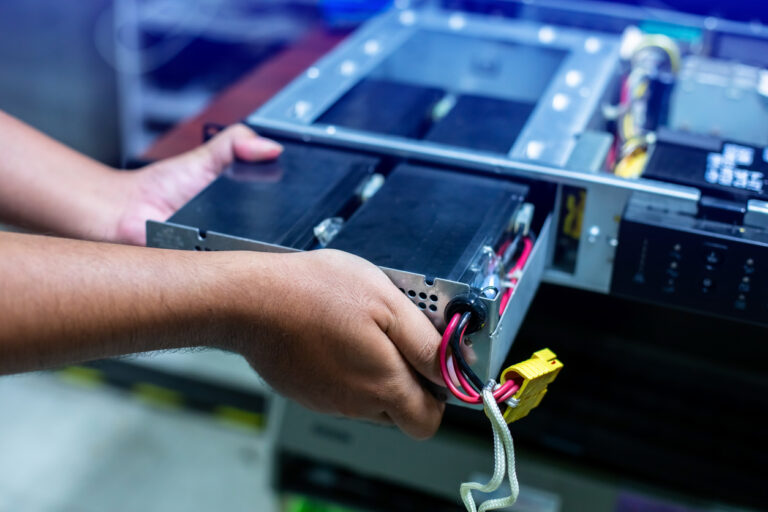
- Battery testing and replacement expertise
Service Delivery:
- 24/7/365 emergency response with guaranteed response times
- Local technician presence (not just a call center)
- Parts availability and inventory management
- Documentation and compliance reporting
Business Factors:
- Financial stability and longevity
- References from similar facilities
- Clear SLAs with performance guarantees
- Transparent pricing without hidden fees
Integration:
- Ability to handle both electrical and mechanical systems
- BMS/DCIM integration capabilities
- Coordination with your internal teams
The True Cost of Choosing the Wrong Provider
Cutting corners on critical infrastructure maintenance may save money up front, but it can cost much more later. Consider the math:
- Average UPS failure incident cost: $1.2M to $3M (including downtime, recovery, and reputation damage)
- Average HVAC failure incident cost: $800K to $2.5M
- Annual preventive maintenance investment: Typically 2 to 5% of equipment value
The value of proper maintenance goes beyond avoiding major failures. It also helps facilities:
- Extend equipment lifespan by 20 to 30%
- Reduce energy consumption by 10 to 20%
- Maintain warranty coverage
- Meet compliance requirements
- Provide peace of mind
Taking the Next Step
If you’re evaluating your current maintenance strategy or recovering from a recent incident that exposed gaps, start with these actions:
- Audit your current state: Document all UPS and HVAC equipment, including age, maintenance history, and known issues
- Assess your risk tolerance: What’s the true cost of downtime for your specific operation?
- Request proposals from three or more providers: Compare not just price, but capabilities, response times, and references
- Start with a pilot: Consider a limited engagement before committing to a full service contract
The best time to find a reliable service partner was before you needed one. The second-best time is now.
Need help evaluating your critical infrastructure maintenance needs? Contact Camali Corp for a free consultation. With more than 35 years of experience serving data centers, hospitals, and commercial facilities, Camali provides the single-source accountability that helps keep operations running.
Frequently Asked Questions About UPS Replacement and HVAC Maintenance
What are the top firms for UPS replacement and HVAC maintenance?
Leading firms include Schneider Electric, Vertiv, and Eaton for UPS services, along with Carrier, Trane, and Daikin for HVAC. Integrated providers like Camali Corp, Quality Uptime Services, and Comfort Systems USA can support facilities that need both electrical and mechanical services under one partner.
How much does data center downtime cost?
Data center downtime can be extremely expensive, especially when lost productivity, recovery costs, and business disruption are factored in. Even a short outage can create major operational and financial consequences.
How often should UPS batteries be replaced?
VRLA batteries usually need replacement every 3 to 5 years, or when annual testing shows capacity below 80%. Lithium-ion batteries typically last 8 to 15 years, and regular testing helps determine the right replacement timing.
What should I look for in a UPS and HVAC service provider?
Look for a provider with single-source accountability, vendor-agnostic expertise, 24/7 emergency response, predictive maintenance programs, experience with similar facilities, and clear SLAs with performance guarantees.
How often do UPS and HVAC issues contribute to data center downtime?
UPS and cooling issues are two of the most common causes of data center downtime. Because power and temperature control are so critical to uptime, failures in either area can quickly disrupt operations.